
The challenge
Model deployment and testing can become fragmented across infrastructure controls, logs and separate prompt tools.
AI Infrastructure System
A private enterprise-product concept for deploying, scaling and orchestrating language models through a developer console and controlled playground.
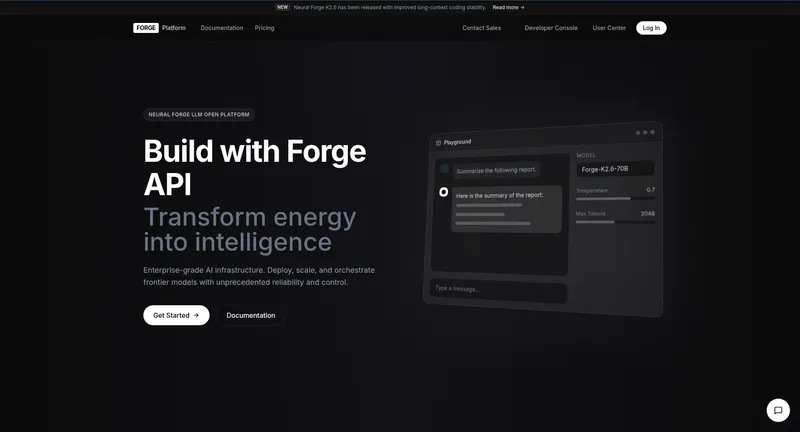
Model deployment and testing can become fragmented across infrastructure controls, logs and separate prompt tools.
Forge was shaped as a unified control surface where technical teams can understand models, deployment state and experiments without losing operational context.
Models and deployment context live in one organised surface.
Testing is connected to the same controlled environment.
System state is designed to remain understandable at a glance.
Forge is a private enterprise-product concept for managing language-model deployment and experimentation through one developer surface. The direction connects a model registry, controlled playground and operational state so technical teams do not lose context between infrastructure tools and prompt tests.
The interface is designed to make model identity, environment and deployment state understandable, but it does not imply that model operations are simple or risk-free. Security, evaluation, cost, data governance and rollback need to sit behind the console. This case study is explicitly a product concept and does not claim public availability, production workloads or benchmark results.
A registry can connect versions, intended use and deployment context so teams know which model and configuration an experiment refers to.
A controlled playground is more useful when prompts, parameters and results remain associated with the same governed environment instead of becoming isolated chat history.
Health, deployment and rollback context should remain understandable at a glance, with deeper logs available when a technical investigation is required.
No. It is presented as a private enterprise-product concept. The case page describes interface and system direction, not a public commercial service or a production hosting guarantee.
Typical controls include identity and role management, secret isolation, network boundaries, audit history, model and prompt evaluation, cost limits, data-retention rules, monitoring and tested rollback. The exact architecture depends on the organisation and deployment environment.
It helps experiments retain model, version and environment context. That makes results easier to reproduce and review than screenshots or unstructured prompt notes, while governance can remain attached to the same workflow.
Tell us what you need to build, who it is for and where you would like to start.